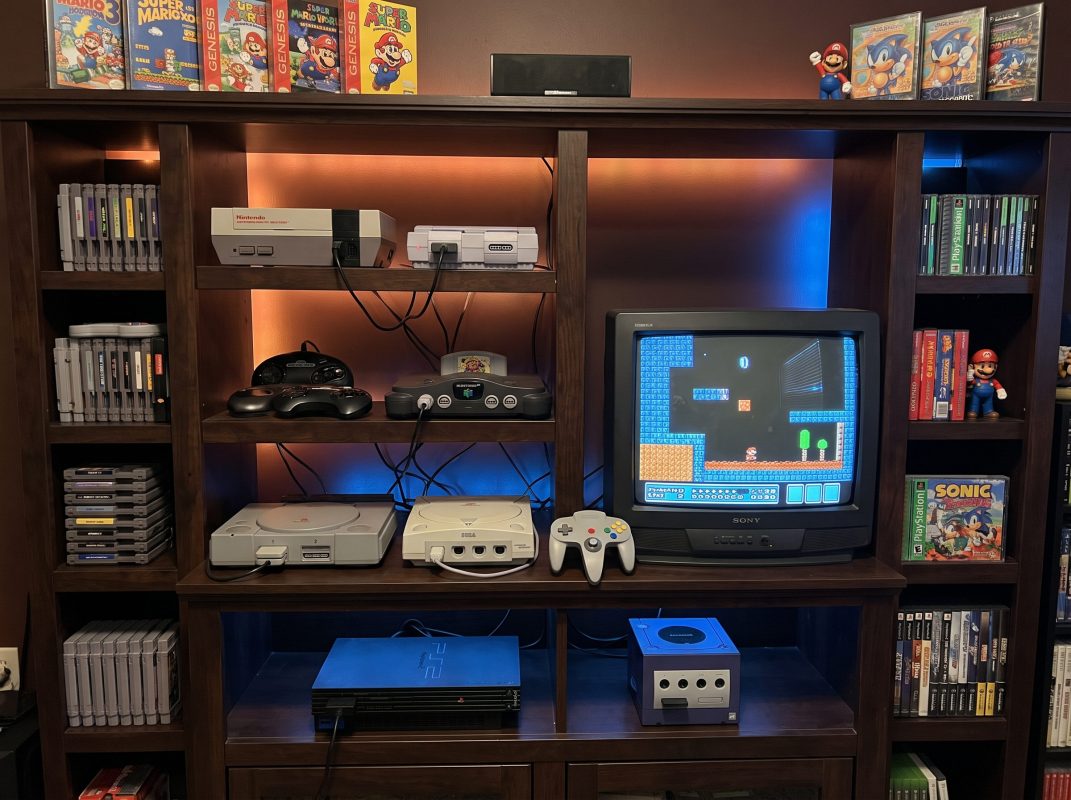
If you spend any amount of time on the repair bench working on 1980s and 1990s microcomputers like the Commodore 64, ZX Spectrum, or Amiga, it doesn't take long before a stack of classic video game consoles and handhelds ends up right beside them. Under the plastic shells, they share the exact same silicon DNA — MOS 6502 derivatives, Zilog Z80A processors, Motorola 68000s, TI SN76489 PSGs, and 74-series TTL glue logic — along with their own notorious power polarity traps, leaking surface-mount capacitors, and proprietary A/V connectors.
Today I'm excited to launch the new Retro Video Game Console Hub Directory (/consoles) on Smiggy's World, expanding our Central Machine Hub Index from 23 systems to 36 complete board-level reference hubs, paired with 11 brand-new interactive console connector pinout pages.
What's Inside Each Console Machine Hub?
Just like our home computer hubs, every Console Hub is built specifically for the electronics workbench so you don't have to hunt through scattered forum threads mid-repair:
- Power Supply Polarity & High-Voltage Warnings: Which consoles use centre-negative vs. centre-positive plugs, which have internal bridge rectifiers, where the soldered green Littelfuse Pico fuses hide, and where high-voltage CCFL backlight inverters sit.
- Architectural Breakdowns & Board Revision Selectors: Compare motherboard revisions at a glance — from 2-PPU vs.
1CHIPSNES boards and discreteYM2612VA3–VA6 Mega Drives toPU-18PlayStations and 1-ASIC vs. 2-ASIC Game Gears. - Symptom-Driven Diagnostic Decision Trees: Step-by-step fault isolation for black screens, blinking lockouts, vertical RGB jailbars, garbled tile VRAM, and optical laser sled calibration.
- Bi-Directional Connector & IC Cross-Linking: Direct links to interactive SVG connector pinouts and DIP/PLCC chip diagrams in our IC Pinout Finder.
Explore All 13 New Console & Handheld Hubs
1. Nintendo Consoles & Handhelds
- Nintendo NES & Famicom Hub (/nes): Ricoh 2A03/2A07 APU & 2C02/2C07 PPU architecture, why the front-loading NES-001 accepts AC or DC while a Famicom blows up on AC, 10NES CIC blinking red light & 72-pin ZIF boiling/restoration, RF box
2200 µFhum-bar recapping, and Famicom Disk System belt calibration. - Super Nintendo — SNES / Super Famicom Hub (/snes): Ricoh 5A22 (65C816) CPU, Dual-PPU vs.
1CHIP-01/02/03& SNES Jr. selector, Sony SPC700 + S-DSP audio module, theF11.5A Pico fuse check, and a full symptom matrix for isolating S-CPU vs. S-PPU1 vs. S-PPU2 silicon failures. - Nintendo 64 Hub (/n64): 64-bit NEC VR4300 + SGI Reality Coprocessor (RCP), why the N64 refuses to boot without a Jumper Pak or Expansion Pak terminating the 500 MHz RDRAM bus, slide-in +3.3V/+12V PSU contact cleaning,
NUS-CPU-01–04THS7374 RGB amps vs. Tim Worthington's N64RGB, and optical thumbstick wheel restoration. - Nintendo Game Boy, Pocket & Color Hub (/gameboy): Sharp LR35902 SoC, DMG-01 6V centre-negative vs. Pocket/Color 3V centre-positive polarity reversal,
-19VDC-CONV LCD bias rail checks, reflowing missing vertical LCD columns, Game Boy ColorC38speaker capacitor replacement, and our 4-board DMG-01 recap reference.
2. Sega Consoles, Add-Ons & Handhelds
- Sega Genesis / Mega Drive Hub (/genesis): Dual Motorola 68000 + Z80A architecture, discrete DIP-24 Yamaha YM2612 (Model 1 VA0–VA6.8) vs. ASIC YM3438 (Model 2 VA0–VA4) selector, the Model 1 (centre-negative) vs. Model 2 (centre-positive) PSU trap, eliminating Sony CXA1145 Pin 6 subcarrier RGB jailbars, and Triple Bypass mods.
- Sega Master System — Mark III / SMS I & II Hub (/sms): Z80A + Sega 315-5124/5246 VDP & YM2413 FM Sound Unit, cracked solder joints on the 7805 voltage regulator, single-pin 50Hz/60Hz refresh rate modding, and tapping native RGB off the RF-only Master System II.
- Sega CD / Mega-CD Model 1 & 2 Hub (/segacd): 12.5 MHz 68000 Sub-CPU, 315-5548 scaling/rotation ASIC & Ricoh RF5C164 8-channel PCM, the notorious green
F3012.5A Pico fuse, Model 1 SMD capacitor corrosion & motorized tray timing marks, Sony KSS-210A / JVC Optima-6 lasers, and non-volatileFM18W08FRAM save upgrades. - Sega Saturn Hub (/saturn): 8-processor architecture (Dual Hitachi SH-2, VDP1 quad sprite engine, VDP2 background processor, SCU DSP, 68EC000 + Yamaha YMF292 SCSP), Type A/B/C internal PSU pinouts, VA0–VA2 SMD capacitor leakage around the
IC20PLL clock synthesizer, JVC Optima-6 / Sanyo SF-P101 laser servicing, and Fenrir/Saroo/Satiator ODEs. - Sega Game Gear Hub (/gamegear): High-voltage
~150V–300V ACCCFL fluorescent backlight safety warning, US/UK (centre-positive) vs. Japanese (centre-negative) DC jack polarity trap, 1-second shutdown protection diagnostics, +34V LCD bias trace repair, and our complete Main, Sound & Power PCB capacitor checklist.
3. Sony, NEC & Atari Consoles
- Sony PlayStation 1 — PS1 & PSone Hub (/ps1): 32-bit R3000A MIPS RISC + GTE + MDEC,
PU-7throughPM-41board selector, complete surface-mount fuse map (PS601–PS605) for dead controllers/rumble/CD motors, fixing dim/rolling PSone composite video (C605/C606),KSM-440ACM/AEM/BAMlaser sled swaps, and xStation ODE installation. - NEC PC Engine, TurboGrafx-16 & Duo Hub (/tg16): Hudson HuC6280 CPU + 16-bit HuC6270 VDC + HuC6260 VCE, PC Engine (centre-negative) vs. Duo (centre-positive) polarity reversal, mandatory 58-capacitor SMD recap &
4558op-amp corrosion repair on the black PC Engine Duo,4.7 µFVCE jailbar fix, and HuCard region pin differences. - Atari 2600 (VCS) & Atari 7800 Hub (/atari2600): MOS 6507 + Stella TIA + 6532 RIOT (128 bytes RAM!) vs. SALLY 6502C + GCC MARIA (7800), 3.5mm Tip-Positive 9V power short warning, fixing black-and-white video caused by heat-damaged
4.7pFpolystyrene "chiclet" capacitors, the RIOT (directions) vs. TIA (fire/paddles) joystick rule, and 7800CD4013soft-power latch repair. - Atari Lynx Model I & II Hub (/lynx): Epyx 16-bit Suzy hardware sprite blitter & 4 MHz 65SC02 Mikey CPU, rebuilding the critical
Q12MOSFET /U6CD4069 /D135.1V Zener power stage before it dumps +9V onto the +5V rail, the Pin 9 & 10 tweezer flex-membrane power test, and why a Lynx never turns on without a cartridge bridging Pins 1 & 31.
11 New Interactive Console Connector & RGB SCART Pinouts
Alongside the console hubs, our Interactive Connector Pinout Reference has grown to 54 dedicated port pages, each with an interactive SVG pin inspector and step-by-step cable building rules:
- Nintendo 12-Pin Multi-Out A/V Port (SNES, N64, AV Famicom & GameCube) — including the critical NTSC Pin 3 CSYNC vs. PAL Pin 3 +12V warning!
- Sega Genesis Model 1 & Master System 8-Pin DIN (262° Horseshoe) A/V Port
- Sega Genesis Model 2, 32X & Nomad 9-Pin Mini-DIN Stereo A/V Port
- Sega Saturn 10-Pin Mini-DIN A/V Port (Universal Sync-on-Luma & RGB SCART)
- Sony PlayStation 12-Pin Multi-AV Port (220 µF RGB Capacitors & GunCon Sync Tap)
- Nintendo NES-001 5-Pin Internal RF / A/V & Power Module Header
- NEC PC Engine 5/8-Pin DIN A/V & 69-Pin Expansion Bus (EXT) Native RGB Tap
- NES 7-Pin Controller & Zapper Port (CD4021 Shift Register Protocol)
- SNES 7-Pin Controller & Mouse Port (16-Bit Serial Protocol)
- Nintendo 64 3-Pin +3.3V Bidirectional Joybus Controller Port
- PC Engine (Mini-DIN-8) & TurboGrafx-16 (Full DIN-8) 74HC157 Controller Port
- Game Boy / Pocket / Color 6-Pin External Link Port (EXT SPI Protocol)
- Atari Lynx 2.5mm ComLynx 16-Player UART Link & 3.5mm 9V Power Port
- Sega Genesis to Sega CD 60-Contact (2×30) Side Expansion Bus
- Updated DB9 Controller Guide — now covering Sega Genesis 74HC157 3/6-button multiplexing, Master System, and Atari 7800 2-button resistor wiring alongside Commodore and Amiga!
Head over to the new Retro Console Hub Directory (/consoles) or use the new Consoles dropdown menu at the top of any page to dive in. And as always, if you have old consoles, controllers, or faulty boards gathering dust in a loft, check out the Rehoming Bench and Retro Tech Donations page!
Comments (0)
No comments yet. Be the first to comment on Smiggy's article!
Leave a Comment