Whether you are chasing down a stubborn address-decoding fault on the repair bench or squeezing a cycle-exact raster routine into a single PAL scanline, switching between dog-eared programmer's reference guides, hex calculators, and command-line assemblers slows everything down. To make low-level 8-bit and 16-bit development and hardware diagnostics faster, I have just added four brand-new interactive utilities to Smiggy's Bench & Diagnostics Tools — bringing our free browser-based workbench up to 19 tools.
Every tool runs 100% client-side in your browser with zero dependencies, instant hardware cross-linking to our 85-Chip IC Pinout Quick-Finder, and direct binary export for emulators and real hardware.
1. Cross-Architecture Visual Memory Mapper & 16-Bit Address Decoder
Launch Tool: https://smiggy.com/bench-tools/memory-mapper
Classic 8-bit machines pack RAM, ROM, character generators, video matrices, and memory-mapped I/O chips into a shared 64 KB ($0000–$FFFF) address space using hardware bank switching. The Cross-Architecture Visual Memory Mapper & Address Decoder lets you visually explore and toggle live memory maps across five flagship architectures:
- Commodore 64 (MOS 6510 / 8500): Toggle CPU Port
$0001bits (LORAM,HIRAM,CHAREN), Cartridge lines (/EXROM,/GAME, Ultimax), and CIA #2$DD0016 KB VIC-II banks in real time to watch 82S100 PLA memory windows switch between BASIC/KERNAL ROM, Character ROM, underlying DRAM, and the$D000–$DFFFI/O block (VIC-II, SID 6581/8580, 2114 Color SRAM, and CIAs). - Commodore VIC-20 (MOS 6502): Toggle
BLK0(+3 KB) andBLK1–BLK5(+8 KB/+24 KB) RAM/ROM blocks and watch the 22×23 Screen Matrix automatically relocate between$1E00and$1000(and Color RAM between$9600and$9400). - ZX Spectrum 48K & 128K (Zilog Z80A): Toggle 128K Port
$7FFDbits to page RAM Banks 0–7 into$C000–$FFFF, switch between the 128K Editor ROM and 48K BASIC ROM, and enable the Bank 7 Shadow Screen. - BBC Micro Model B (2 MHz MOS 6502A): Switch screen modes (
MODE 0–7) to seeHIMEMdynamically resize video memory between$3000(20 KB) and$7C00(1 KB Teletext), select Sideways ROM slots viaROMSEL ($FE30), and inspect the 1 MHzFRED,JIM, andSHEILA ($FE00–$FEFF)hardware pages. - Atari 800 / XL / XE Series (MOS 6502C “SALLY”): Toggle 6520 PIA
PORTB ($D301)bits to bank out Atari BASIC (simulating holdingOPTIONon boot), map the$5000–$57FFSelf-Test Diagnostic ROM, and inspect ANTIC, GTIA, and POKEY registers.
It also includes a 16-Bit Address Decoder (converting any hex or decimal address like $0400 or 53280 into Little-Endian Low/High byte splits, 6502/Z80 pointer code, and A15..A0 address bus logic states), an interactive Visual Video RAM Screen Coordinate Mapper, and a custom .EQU symbol exporter.
2. BASIC-to-Assembly Code Translator, Line Number Stripper & .PRG Binary Tokenizer
Launch Tool: https://smiggy.com/bench-tools/basic-to-assembly
Porting a prototype from 8-bit BASIC into machine code — or cleaning up spaghetti line numbers — is now a single click. The BASIC-to-Assembly Code Translator & Line Number Stripper supports Commodore BASIC V2 (C64/VIC-20), Sinclair BASIC (ZX Spectrum), and Locomotive / BBC BASIC (Amstrad CPC & BBC Micro):
- Line Number Stripping & Dynamic Relabeling: Scans all
GOTO,GOSUB,THEN <line>, andRESTOREbranch targets, strips unreferenced line numbers, and converts targets into named labels (e.g.,GOTO 100→JMP line_100,GOSUB 500→JSR line_500,RETURN→RTS). - Hardware
POKE&PEEKOpcode Transformer: Automatically identifies hardware addresses in your BASIC code and emits commented 6502/6510 or Z80 instructions:20 POKE 53280, 0 : POKE 53281, 0 100 R = PEEK(53266) ; --- Translated 6502 / 6510 Assembly --- LDA #$00 ; POKE 53280, 0 STA $D020 ; VIC-II Border Colour Register EXTCOL (53280) LDA #$00 ; POKE 53281, 0 STA $D021 ; VIC-II Background Colour 0 BGCOL0 (53281) line_100: LDA $D012 ; R = PEEK(53266) (VIC-II Raster Scanline Counter) STA zp_R - Authentic Client-Side Commodore
.PRGTokenizer: Converts plain ASCII BASIC source directly into a binary Commodore.PRGfile complete with the 2-byte Little-Endian load address ($0801C64,$1001/$0401/$1201VIC-20, or$1C01C128), linked 16-bit next-line pointers, 16-bit line numbers, single-byte CBM V2 tokens ($80–$CB), and null terminators — ready to download and run in VICE or on real hardware.
3. Multi-System Opcode Lookup, Status Flag Visualizer & Cycle Counter (6502, Z80 & 68000)
Launch Tool: https://smiggy.com/bench-tools/opcode-lookup
When writing display list interrupts, VIC-II raster splits, or Z80/68000 block loops, every clock cycle and status flag matters. The Multi-System Opcode Lookup & Cycle Counter combines three complete CPU references and a timing calculator in one page:
- Three Complete Instruction Sets: Switch instantly between MOS 6502 / 6510 / 8500 (all 151 official opcodes plus 11 popular undocumented 6510 raster opcodes like
LAX,SAX,DCP,ISB,SLO, andANC), Zilog Z80 / Z80A, and Motorola MC68000 (Amiga & Atari ST). - Visual Processor Status Flag Matrix: Filter or inspect how any opcode modifies the processor flags —
N V - B D I Z Con 6502,S Z H P/V N Con Z80, andX N Z V Con 68000 — colour-coded by Modified (*), Set (1), Cleared (0), or Unaffected (-), alongside a sibling table comparing all addressing modes for the selected mnemonic. - Raster-Timing Assembly Cycle Calculator: Paste any assembly snippet to calculate line-by-line and cumulative clock cycles or Z80 T-states. Toggle Branches Taken (
+1c) and Page-Boundary Crossed (+1c/+2c) penalties and measure your routine against selectable scanline budgets (63 cycles for a PAL C64 line, 23 cycles for a C64 badline, 224 T-states for ZX Spectrum 48K, or ~454 cycles for Amiga/Atari ST).
4. In-Browser 6502 & Z80 Cross-Assembler, Disassembler & .PRG / .TAP Binary Studio
Launch Tool: https://smiggy.com/bench-tools/retro-assembler
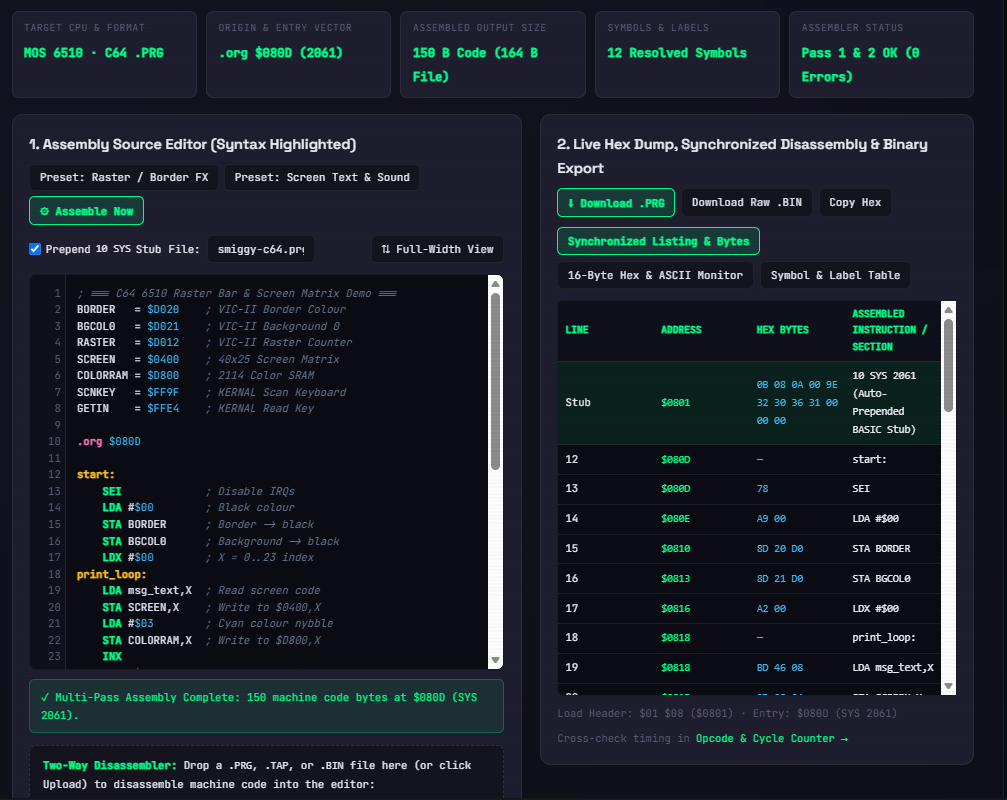
Once your routine is designed and timed, you can assemble it directly in your browser with the In-Browser 6502 & Z80 Cross-Assembler & Disassembler:
- Syntax-Highlighted Editor & Multi-Pass Compiler: Supports labels,
.org/* =origins,.equ/=constants, low/high byte operators (#<label/#>label), and.byte/.word/.text/defb/defwdata directives with automatic Zero-Page optimization and inline error diagnostics (catching undefined symbols or out-of-range relative branches). - Synchronized Machine Code Listing, Hex Monitor & Symbol Table: Inspect the exact hex bytes emitted beside each source line, browse a 16-byte Hex & ASCII monitor dump, or jump from any resolved symbol directly into the Visual Memory Mapper.
- One-Click
.PRG&.TAPExport + Two-Way Disassembler: Download ready-to-run Commodore 64 / VIC-20.PRGbinaries (with an optional auto-prepended10 SYS 2061/10 SYS 4109BASIC autostart stub) or Sinclair ZX Spectrum.TAPCODEtape images. Have an existing.PRG,.TAP, or.BINfile? Drag and drop it onto the disassembler bar to decompile the binary back into editable 6502 or Z80 source code!
Try Them Out on the Workbench
All four tools are live right now and 100% free to use:
- Cross-Architecture Visual Memory Mapper & 16-Bit Address Decoder
- BASIC-to-Assembly Code Translator, Line Number Stripper & .PRG Tokenizer
- Multi-System Opcode Lookup, Flag Visualizer & Cycle Counter (6502, Z80 & 68000)
- In-Browser 6502 & Z80 Cross-Assembler, Disassembler & .PRG / .TAP Studio
Got a feature request, a favourite undocumented opcode, or an old box of faulty 8-bit hardware gathering dust in the loft? Leave a comment on any bench tool page, check out the Rehoming Bench, or get in touch via the Retro Hardware Donation Drive!

Comments (0)
No comments yet. Be the first to comment on Smiggy's article!
Leave a Comment