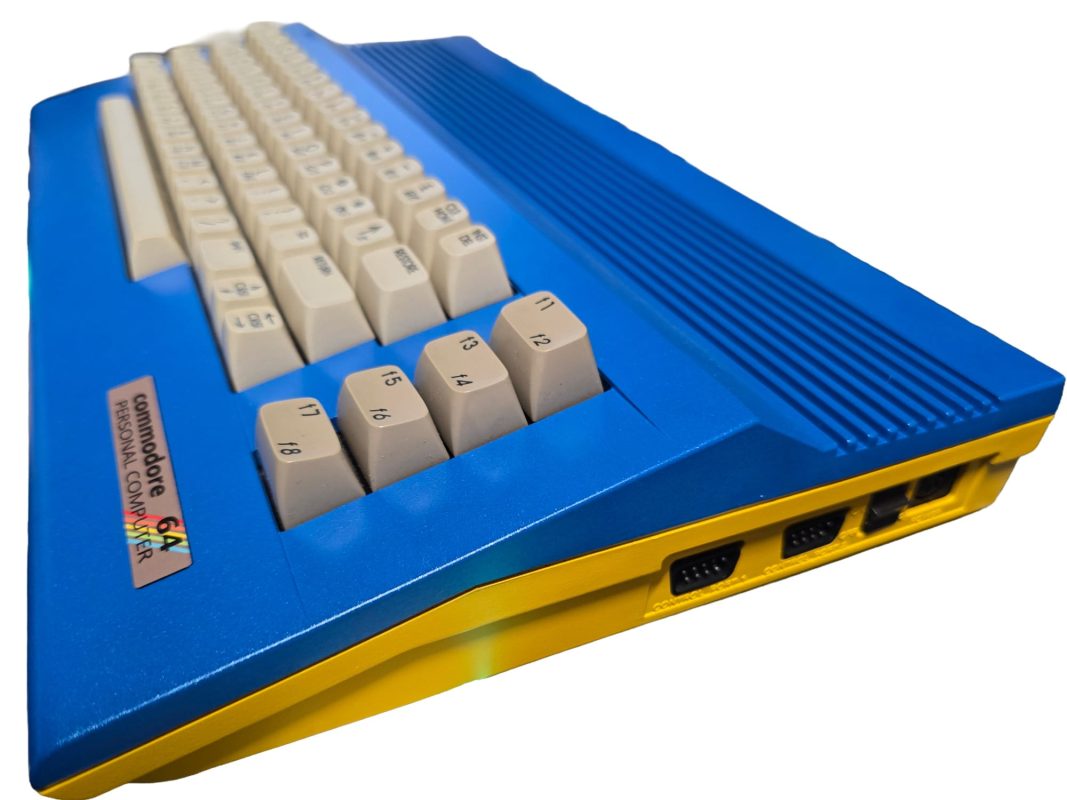
There is a new addition to the Bench Tools section, and it is the one I have wanted on this site for a long time: a Recap & Repair Reference.
If you have ever sat at the bench with a board in front of you, a soldering iron warming up, and a browser full of contradictory forum posts about which capacitor goes where, this is for you. Ten guides are live, covering fifteen individual PCBs and 144 capacitor positions.
What is in it
| Machine | Board | Caps |
|---|---|---|
| Commodore 64 | ASSY 326298 — first breadbin, 5-pin video | 18 |
| Commodore 64 | ASSY 250407 — early long board | 19 |
| Commodore 64 | ASSY 250425 — standard long board | 6 |
| Commodore 64 | ASSY 250466 — last breadbin | 7 |
| Commodore 64C | ASSY 250469 / 252311 — short board | 9 |
| Amiga 500 | Rev 3 / Rev 5 | 16 |
| Amiga 500 | Rev 6A / Rev 7 | 17 |
| ZX Spectrum 48K | Issue 3 | 13 |
| Game Boy DMG-01 | CPU, LCD, jack and DC converter boards | 19 |
| Sega Game Gear | VA1 — main, sound and power boards | 20 |
Every guide gives you the designator, the value, the voltage rating and the package for each position, along with notes where a particular part has a quirk worth knowing about.
The bit I care about most: honest sourcing
There is a lot of capacitor information floating around the retro scene, and some of it is simply wrong. Values get copied from one page to another, designators get muddled between board revisions, and nobody says where the numbers came from. Fit the wrong part and at best it does not fit the footprint; at worst you have desoldered a perfectly good capacitor for nothing.
So every row in these guides carries a badge:
- Verified — two or more independent sources agree on this value.
- Check — the value is revision-dependent, or only one source documents it. Confirm it against your own board before you order.
Of the 144 positions, 110 are Verified and 34 are flagged Check. The Amiga 500 Rev 3 / Rev 5 page is flagged Check from top to bottom, because only one capacitor list for that board exists that I could find, while the Rev 6A has two that agree. That page says so plainly rather than pretending to more certainty than I have.
Every guide also lists the sources it was built from, with links, so you can go and check my work. Where a vendor sells a ready-made kit for that board, that is linked too.
Things that make it useful at the bench
- A rolled-up shopping list. Rather than counting rows yourself, each guide totals the positions by value — "15 x 10 uF 25 V Radial" and so on — with a copy button so you can paste it straight into a parts order.
- "Is this your board?" Every guide opens with how to tell that revision apart from its near neighbours. The C64 alone had five mainboards, and the difference between a 250425 and a 250466 is one capacitor.
- Multi-board machines handled properly. A Game Boy recap is four separate PCBs and a Game Gear is three. Each board gets its own list and its own totals, plus a combined list for the whole machine.
- Safety notes that actually matter. The C64 pages lead with the power supply, because recapping does nothing about an original Commodore brick failing high and killing your RAM and SID. The Amiga pages lead with the A501 trapdoor battery, which does far more damage than any capacitor on the mainboard. The Game Gear pages tell you to check the pads for electrolyte damage before fitting anything new.
- Suggested parts. Where a source documents specific replacements, the manufacturer part numbers are listed — Panasonic and Mouser codes for the Amiga 500, Vishay for the Spectrum.
It is in the site search too
Search the site for 250469, 10uF, C19 2200uF, game gear caps or even a part number like EEUFR1H101 and the right guide comes back. Handy when you are stood over a board and cannot remember which revision you are looking at.
A word of caution
These guides are a reference, not a substitute for looking at your own board. Board revisions varied mid-production, service centres modified machines, and previous owners have often been in there before you. Read the value off the can before you order, and if what you find disagrees with what I have published, trust the board — then drop me a line so I can correct it.
What is coming next
The plan from here is the remaining ZX Spectrum issues, then the VIC-20, C128 and 1541, the Amiga 600 and 1200 (surface mount, so a rather different job), the Atari ST, and the Mega Drive, NES and SNES. I am also looking at a boot and error code decoder — Amiga Kickstart screen colours, C64 dead test patterns, that sort of thing — because as far as I can tell nobody has built a decent interactive version of that.
If there is a machine you would like covered, or you spot something wrong in what is already there, get in touch. Photographs of your own boards are especially welcome, since they are the best way to settle a disputed designator.

Comments (0)
No comments yet. Be the first to comment on Smiggy's article!
Leave a Comment