When you look back at the 8-bit home computer explosion of the early 1980s, machines like the ZX Spectrum and Commodore 64 usually steal the spotlight for gaming nostalgia. But if we talk about pure engineering excellence, educational impact, and shaping an entire nation’s digital future, one machine stands head and shoulders above the rest: the BBC Microcomputer System.
Built by Acorn Computers in Cambridge, it wasn't just a gadget—it was a bold national initiative that changed how Britain viewed technology.
Where It All Began: My First Taste of Code
For me, the BBC Micro isn't just a piece of vintage computing history; it's where my entire obsession with technology began.
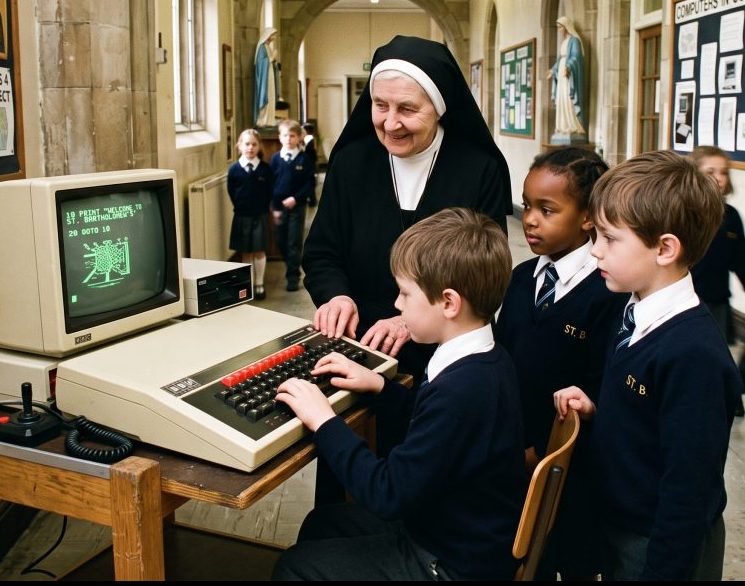
Over 45 years ago, in the computer room at St Bartholomew's, I sat down in front of a BBC Micro for the very first time. Like millions of kids across the UK, I stared at that prompt screen, tapped away at the chunky mechanical keyboard, and typed out my very first line of code:
10 PRINT "HELLO WORLD"
20 GOTO 10
RUN
Watching those words endlessly scroll down the screen was a lightbulb moment. Right then and there, the programming hook dug in deep. It wasn't just about making text appear; it was the immediate realization that I could command this machine and make it do whatever I wanted. That early curiosity—wondering "what else can I make this thing do?"—set the stage for a lifelong passion for coding, tinkering, and electronics.
The BBC Literacy Project: A Masterclass in Innovation
To appreciate the BBC Micro, you have to look at the sheer ambition behind its creation. In 1979, the BBC recognized that the UK was falling behind in computer literacy. Instead of just broadcasting documentaries, they launched the BBC Computer Literacy Project and set out to pair television programming with a standardized microcomputer.
Acorn Computers famously won the contract by building a working prototype of the Proton (which became the BBC Micro) in just four days.
When launched in late 1981, it was an absolute powerhouse compared to its budget competitors:
- BBC BASIC: Designed by Sophie Wilson, BBC BASIC was far superior to standard Microsoft BASIC. It offered structured programming constructs (
WHILE...WEND,REPEAT...UNTIL), advanced graphics commands, and an integrated 6502 assembler right out of the box. - Overbuilt Hardware: It featured a rugged cream-colored casing, a full-travel mechanical keyboard, and distinct red function keys built to survive the punishment of school classrooms.
- Unmatched Expansion: Built like a piece of lab equipment, it came packed with ports—Econet networking, tube coprocessor interfaces, analog inputs (paddle controllers/joysticks), RS-232 serial, and a user port.
Dominating the Classroom
Through the Department of Industry's 50% subsidy scheme, schools across Britain were incentivized to install BBC Microcomputers. By the mid-1980s, over 80% of UK primary and secondary schools had at least one BBC Micro sitting on a trolley, often connected to a monochrome green monitor or portable TV.
It was in these classrooms that a generation of British engineers, developers, and makers wrote their first lines of code. Schools used them for everything:
- Basic Programming: Learning BBC BASIC, drawing vector graphics with
DRAWandMOVE, and manipulating sound channels. - Control Technology: Using the user port to control Lego buggies, traffic light simulations, and robotic arms.
- Econet Networks: Linking classroom computers together to share floppies and printer access long before local networking was commonplace in homes.
The Lasting Legacy: From BBC Micro to ARM
The BBC Micro didn't just teach kids how to code; its architectural legacy literally powers the modern world.
When Acorn realized the 6502 chip inside the BBC Micro was hitting its performance limits, their engineering team (led by Sophie Wilson and Steve Furber) decided to design their own 32-bit processor inspired by the simplicity of the BBC Micro's system architecture.
That project yielded the Acorn RISC Machine—better known today as ARM. Every modern smartphone, tablet, Apple Silicon Mac, and embedded microcontroller traces its roots back to the lessons learned while designing the BBC Micro.
Final Verdict
While the ZX Spectrum gave us cheap games and the Commodore 64 gave us incredible sound, the BBC Micro gave Britain a generation of tech pioneers. For me, sitting in St Bartholomew's all those years ago, it provided the spark that started it all.
Without that robust machine and its brilliant BASIC interpreter, my journey into coding and electronics hardware might have taken a completely different path.
Is it Britain's greatest computer? Without a shadow of a doubt.
Comments (0)
No comments yet. Be the first to comment on Smiggy's article!
Leave a Comment